
Between the ages of four and six, the child’s brain is in a phase of intense neural networking. Activities that stimulate multiple senses at the same time while offering structured yet playful processes have a particularly lasting impact on development during this period.
What happens in the brain when a child draws?
When a child aged 4–6 draws, several systems work together simultaneously:
- visual perception (recognizing shapes, lines, and areas),
- fine motor control of the hand (precise, controlled movements),
- attention and endurance,
- and the brain’s planning functions (sequence, pace, decision-making).
This simultaneous activation is known as visual-motor integration. It forms a fundamental prerequisite for later academic skills such as writing, reading, and mathematical thinking.
Regular drawing supports the maturation of these neural connections, strengthens coordination between hand and brain, and creates a stable foundation for learning processes – without performance pressure and without evaluation.
Why is the preschool age (4–6 years) especially important?
The preschool years are considered a sensitive developmental phase. During this time, the nervous system is particularly receptive to experiences that are:
- repeatable,
- clearly structured,
- yet still allow room for self-initiative.
Drawing fulfills all of these criteria. Children not only learn motor sequences, but also practice focusing over a period of time, starting and completing tasks, and making their own decisions.
A well-designed drawing activity can have greater impact than targeted drills during this phase, because learning happens playfully and through intrinsic motivation.
Why the quality of the coloring book matters
Not every coloring book supports these developmental processes equally. Overly detailed motifs, cluttered images, or demands that are too high can overwhelm children and lead to frustration.
An age-appropriate coloring book for preschool children is characterized by:
- clear, easily recognizable lines,
- flexible levels of difficulty,
- opportunities for success,
- and freedom for creativity.
This is exactly why it matters which coloring book a child is given.
Recommendations for parents
- Offer drawing regularly, but without pressure.
- Allow your child to work at their own pace.
- Avoid correcting or evaluating the result.
- Focus more on the process than on the finished picture.
The goal is not a “beautiful picture,” but the development of fine motor skills, concentration, and inner security.
Recommendations for educators & early childhood professionals
- Choose age-appropriate motifs with suitable levels of detail.
- Combine free drawing with structured coloring tasks.
- Use drawing activities as calm transition or focus phases.
- Observe posture, grip, and endurance – not the final result.
Drawing can be used deliberately to support visual-motor integration and to prepare children for future academic demands.
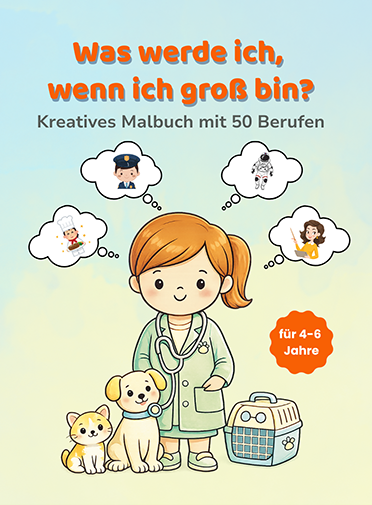
I am happy to recommend my coloring book for children aged 4 and up: What Will I Be When I Grow Up? – A creative coloring book with 50 professions for children aged 4–6
It was deliberately designed according to developmental psychology principles.
It includes 50 motifs, each accompanied by a short text and an age-appropriate question. This turns drawing into not only a creative activity, but also a playful invitation to think, speak, and reflect.
In the next posts of this blog series, we will explore individual areas of development step by step – from fine motor skills and concentration to the emotional meaning of colors.
English editions coming soon
Some of the book covers you see are currently shown in their German edition.
The English versions are already in progress and will be released soon.
Sign up for the newsletter to be the first to know when the English editions become available and to receive gentle updates about new books and projects.